Occupational safety of rock milling in ONKALO improved through team work
Cutting and milling rock into a level access road deep in the underground areas of Posiva’s ONKALO® facility is a dusty, loud, and wet operation surrounded by a water mist. The excavator milling cutter used for the finishing of the final disposal facilities for spent nuclear fuel is one of Posiva’s unique machines which is in operation almost continuously and therefore a very suitable candidate for improvement of occupational safety.
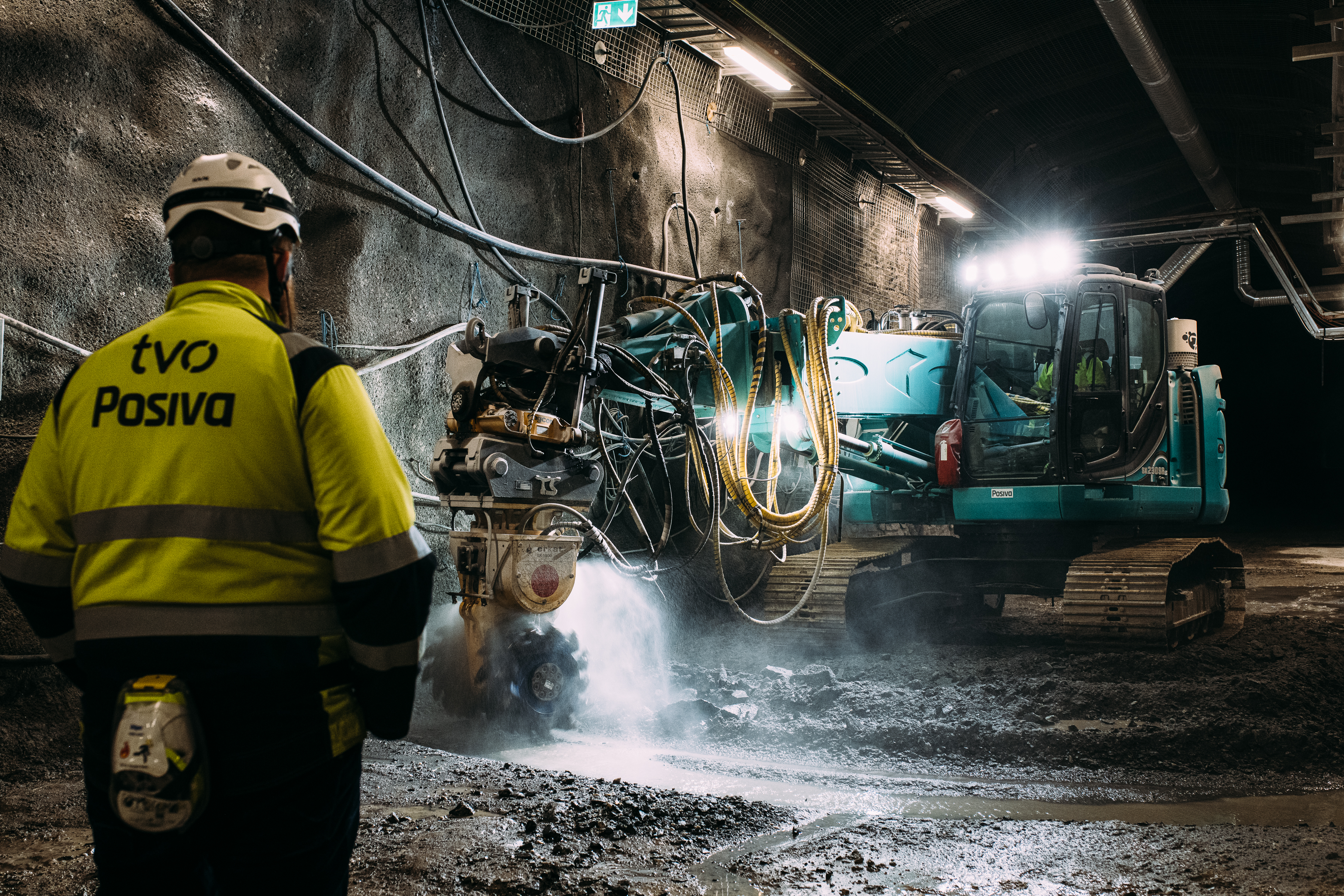
Posiva’s Occupational Health and Safety Specialist Juho Syren watches the cutting head of the milling cutter rotate in the water mist, with Lauri Suominen as the operator of the machine.
Right now, milling is carried out in central tunnel 5. The first five 350 metres long actual final disposal deposition tunnels already branch out from this tunnel. In time, both the high-level radioactive final disposal canisters and all the equipment needed for the backfilling of the tunnel will travel along the central tunnel. For this reason, quite stringent quality requirements have been specified for the milling of the tunnel. The goal is to level the rock surface to the standard required for the tunnel’s final purpose of use.
- I must admit that the milling cutter gave us several grey hairs at first, says Juho Syren who works as the Occupational Health and Safety Specialist for Posiva.
Dust management the greatest challenge
According to Syren, the law imposes requirements on dust management in milling work. Another area in the operation of the machine requiring development has been the reduction of noise. The improvement of air quality in the tunnels has also been strived for by reducing the emissions of the combustible-engine machine.
The milling of rock produces a considerable amount of crystalline silicon dioxide and quartz dust, or silica dust. It is particularly harmful to health. Posiva considered silica dust issues already during the procurement process of the machine. Based on the observations made in the first operational tests, the machine was developed further in order to achieve the best possible end result.
- We have already made a lot of progress in occupational health and safety. We have installed dust control equipment on the milling cutter, bringing the amount of dust through technical measures to such a low level that additional respirators are no longer needed in the tunnel. This has a significant impact on the physical well-being of the workers during the working day, Syren says.
- Although the conditions are wet and muddy in the tunnel during the milling operation, the machine operator sits in a pressurised and insulated cabin.
Posiva deploys a multidisciplinary work group
Syren tells that all the measures were developed as team work in Posiva’s multidisciplinary work group. The group has included representatives of rock construction, machine operators, maintenance, and various sectors of safety (occupational, fire, and environmental safety). Together they have created solutions that bring the exposure effects caused by the machine to almost a zero level.
Without these measures, a considerable amount of personal protective equipment would be needed in the operation of a similar machine, in terms of both hearing and respiratory protection. Syren says he is truly grateful that the risks related to milling were overcome already during the design and construction stage of the machine. According to him, not many workplaces give you a chance to engage so widely with different organisations in matters of occupational health and safety.
- To use ice-hockey terms, Posiva now has its number one power-play unit on the ice producing results.
All in all, Posiva has recruited eight operators. Three of the operators work in the above-ground encapsulation plant and five in the underground repository. Two of them have flexible job descriptions including also other tasks.
Here's the Excavator Milling Cutter in a Nutshell
The machine is officially known as an excavator milling cutter. It consists of an excavator chassis, a specially manufactured boom set, and a cutting attachment. The machine is used to level rock surfaces to a standard that meets the requirements of the production equipment. The machine is mainly operated by specifically appointed operators employed by Posiva’s contract partner. It can also be operated by Posiva’s own operator.
Posiva procured the machine as new in 2023. Multidisciplinary analyses related to availability, safety, and operator ergonomics were conducted already at the procurement stage of the machine. The machine features a cabin provided with special equipment. It is pressurised and provided with a filter that removes 99.9% of ambient air impurities. This is particularly important when operating the machine in narrow and low tunnels.
The previous machine had problems with the operator’s exposure to vibrations caused by the hard rock surface. With the new machine, the risks were considered in multidisciplinary team work already at the procurement stage and vibrations were reduced to a fraction compared to those of the previous machine.
Text: Pasi Tuohimaa
Photo: Tapani Karjanlahti
Share