Following a long professional career in mining, at the age of 36, Ville Paalumäki started studies in geology and ended up working for Posiva Oy as an expert in hydrogeology
Ville Paalumäki has separated, blasted, and scaled rock, and learned about the use of drone technology in land surveying. Studies in geology strengthened an approach based on natural sciences to analyse phenomena in the bedrock.
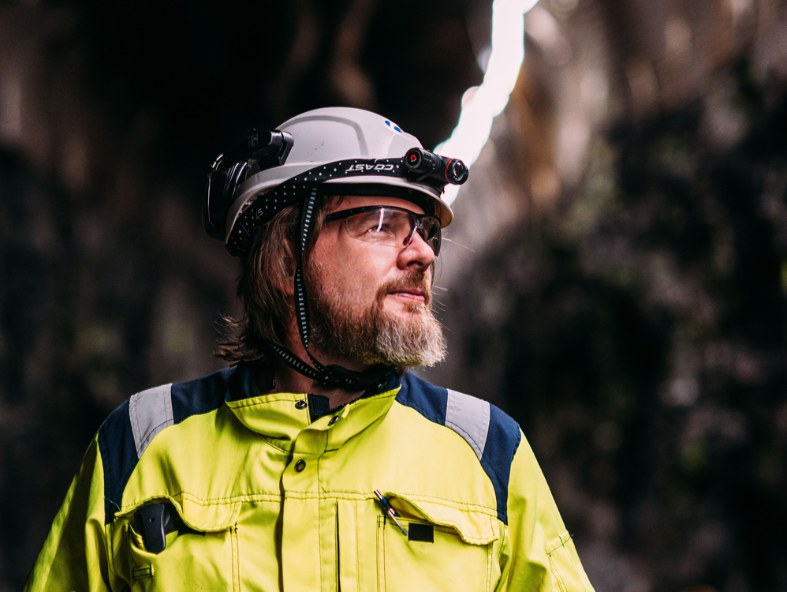
For Ville Paalumäki, 43, the career path leading to the position of hydrogeologist at Posiva Oy has been long and winding, even unusual. Over the years, Paalumäki has built a broad base of education and experience in the mining industry. He started in Posiva’s employ in 2023 having all but completed his degree of Master of Philosophy from the Master’s track in quaternary geology at the University of Turku.
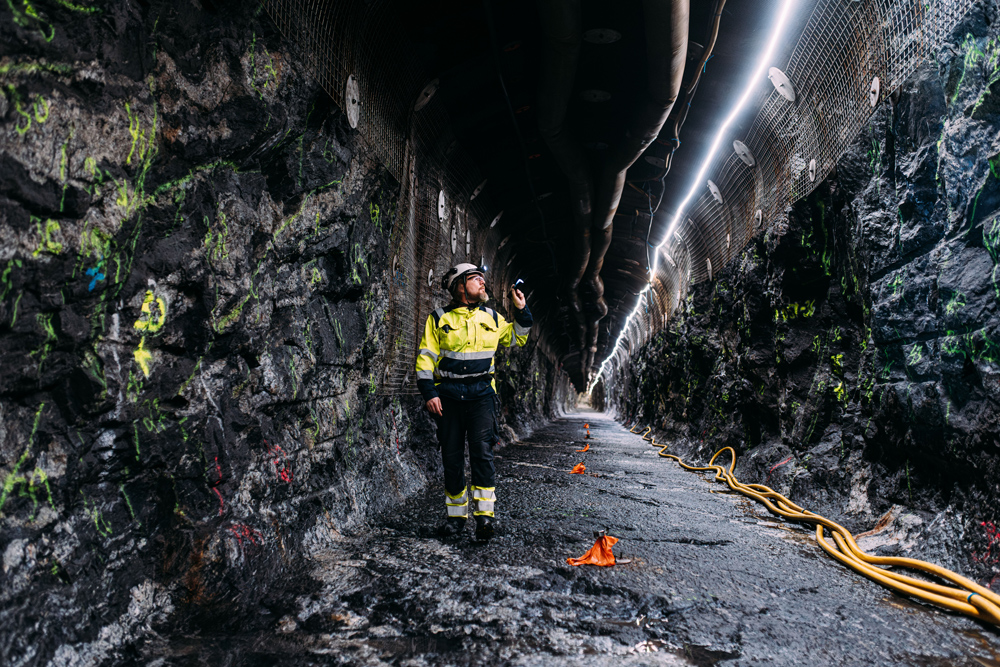
- My work at Posiva primarily focuses on the monitoring of leakage water in ONKALO® and studying the physical properties of the water, as well as on pressure monitoring in the deep boreholes, Paalumäki explains.
Despite being 1.9 billion years old, the stable bedrock in the area of ONKALO® still has water moving in the fractures. Rock construction below the groundwater level causes changes in water flows in the bedrock. And these are what a hydrogeologist studies. The final disposal canisters and deposition holes are placed in rock zones where fracturing and groundwater movement are at a minimum.
- I feel that my work is a part of the verification of the safety of final disposal. Specific criteria and limit values have been defined for the final disposal bedrock, and my task is to control that they are met, as part of Posiva’s monitoring programme. The monitoring of leakage water will be important also when the final disposal operation is started in ONKALO®. The operational stage of final disposal of spent nuclear fuel will coincide with the excavation of new deposition tunnels, which makes it necessary to constantly monitor the properties of the bedrock, Paalumäki elaborates.
In Paalumäki’s opinion, what makes his work particularly important is that the research and development efforts of Posiva over a long period of time have made it possible for Finland to be the first country in the world to start the final disposal of spent nuclear fuel.
Original dream to be a teacher
Paalumäki spent his childhood and teen years in Lappeenranta. His father used to work in the mining industry, which gave the young boy a taste of his future career. His first personal experience of the industry was a summer job at the age of 14 as a tennis court attendant for the mining company.
- After graduating from senior secondary school, I thought about becoming a teacher and to that end, spent some time working as a teacher’s assistant. I drifted into mining when I was hired as a rock sorter at Nordkalk’s Lappeenranta mine. The job simply entailed separating rocks by colour.
The dream about the teaching profession was gradually forgotten when Paalumäki started to study excavation engineering at the North Karelian Adult Education Centre in Outokumpu.
- This included also theoretical studies for a blaster’s licence. To obtain the work practice required for the licence, I worked in the Parainen mine of Nordkalk and continued to work there for several years after completing my studies. I found a blaster’s work interesting, because it was physical work with high responsibility. I also carried out a lot of other duties connected to excavation, such as drilling using a bull drifter as well as scaling, i.e., removing loose rock from excavated surfaces.
While working in Parainen, Paalumäki also completed vocational degrees in civil engineering and mining. In addition to this, he also achieved a Diploma from the Technical Training Programme in rock, mining, and civil engineering at Rastor Instituutti.
Second attempt opened doors to university
Having completed his additional studies while working, Paalumäki was employed in Nordkalk’s Geology Department as a mine surveyor. He was at the same time studying at Adult Education Centre Tavastia for a qualification in land surveying.
- A little over ten years ago, drones were introduced to assist in land surveying. I familiarised myself with their use, because the application of drones in land surveying sounded interesting. I had the opportunity to be involved in developing the utilisation of photogrammetric point clouds for use in mining design and volume calculation.
Most of Paalumäki’s colleagues were geologists by education and this further increased his interest in university studies. One of the co-workers urged Paalumäki to sit the entry tests to the University of Turku.
- I was not admitted at the first attempt, but the second time I prepared for the tests so well that the doors of the university opened to me.
Paalumäki says that at 36 years of age, he was a senior among the young students.
- Despite the age gap, I made many new friends with my fellow students and still remain in contact with them. I wanted to specialise in quaternary geology, because it gives you a broad knowledge base to environmental studies. I am interested in environmental studies related to mines, as I feel my background in mining gives me a specific skill set in this field.
University studies gave new perspective
Paalumäki says that he has over the years seen many types of mines, and quarries, and excavation methods. The studies in geology gave Paalumäki a perspective based on natural sciences to analyse the phenomena he had witnessed when working in mines.
- During my studies, I worked at the Geological Survey of Finland, for example, and also wrote my thesis there. Towards the end of my studies, I landed a summer trainee post at Posiva. From that post I transferred into a two-year fixed-term position of hydrogeologist until in March 2025, I was employed on a permanent contract.
According to Paalumäki, ONKALO® shares many similar elements with mines.
- A significant difference compared to the mining industry is the timeline of final disposal, which is in a completely different class. The final disposal operation will continue for more than one hundred years before the repository tunnels are closed for good. This means that it differs fundamentally in terms of the standard and requirements applied to both rock construction and building engineering – starting with lighting.
Paalumäki moved to Rauma from Turku when he started in Posiva’s employment. At present, he lives in the Ota area of Rauma. His partner, a fellow student of geology, still lives in Turku but spends much of her time also in Rauma. Paalumäki balances work with gym training and trekking in forests with hist 10-year old white miniature schnauzer.
- Also, I am completely hooked on fly fishing. There are not many streams or rivers suitable for fly fishing, but one can also use a fly to catch pike in the sea, for example. So there is no shortage of fishing water, he chuckles.
Paalumäki, who gives the appearance of a man quite happy with his life, says that the best components of working as a hydrogeologist at Posiva include good co-workers, an emphasis on natural sciences, as well as the strong cross-scientific approach to research.
Text: Timo Sillanpää
Photos: Tapani Karjanlahti