How can we be certain of the long-term safety of final disposal?
Mankind has been able to write for five-six thousand years and cultivate land for about 12 thousand years. The modern human, or Homo sapiens, first appeared in the world in Africa as late as about 300,000 years ago. These timelines provide a good comparison for the time perspective of Posiva’s final disposal operation. It has to be said, however, that the question of how Posiva can promise the safety of the final disposal of spent nuclear fuel even after a hundred thousand years is an excellent question.
The premise is simple: Only safe final disposal is possible. For this reason, the key to final disposal is the long-term safety of the solution which is assessed and demonstrated with the Safety Case.
According to the international definition, the Safety Case refers to all the technological and scientific data, analyses, observations, trials, tests, and other evidence used to justify the reliability of the assessments made of the long-term safety of final disposal. In other words, the work that Posiva has been carrying out for the past 45 years.
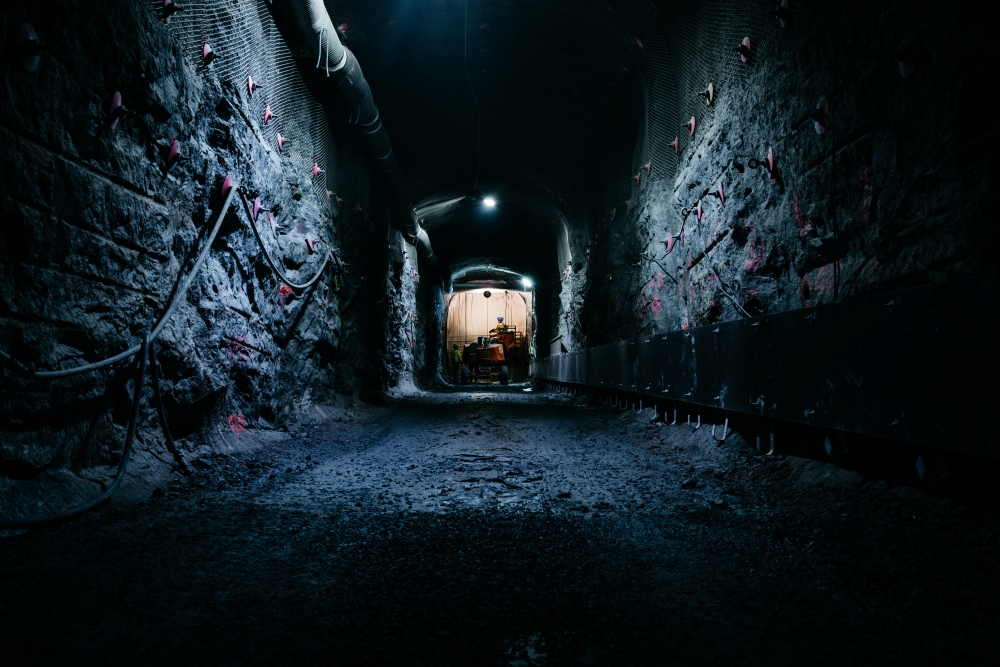
Deep geological final disposal is the one of the various studied options for final disposal that offers the best possibilities to isolate high-level nuclear waste from the human environment, or the biosphere. The site reserved for such waste is inside the stable bedrock of Olkiluoto at a depth of more than 430 metres.
Supercomputer-based modelling
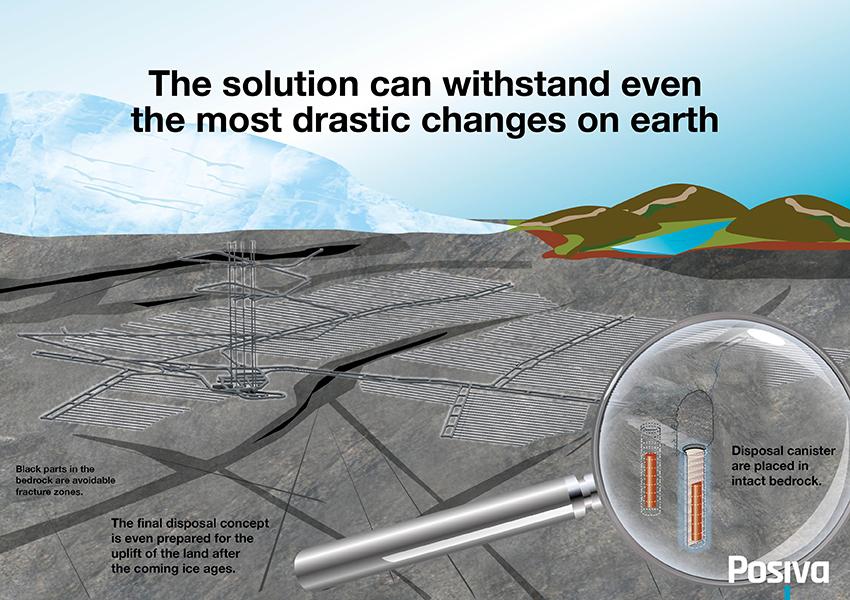
The design base applied to the long-term safety of geological final disposal comprises not only criteria related to nuclear and radiation safety, but also assessments of the various changes occurring in nature. We are not speaking of some trivial occurrences, but phenomena such as earthquakes and future ice ages up to a million years from now. The resistance of the final disposal solution to these phenomena has been analysed using supercomputer modelling, for example.
The final disposal operation of Posiva takes place deep inside the bedrock which has been geologically highly stable for hundreds of millions of years. The stability of the ground is indeed one of the reasons that has made Finland a good candidate for geological final disposal in the first place. To be precise, the bedrock in Olkiluoto is almost 1,900 million years old. A hundred thousand years is thus a mere blink of an eye compared to that.
The Finnish bedrock consists of rock sections separated by fracture zones originating from hundreds of millions of years ago. The final disposal canisters will not be placed in the fracture zones, but inside intact rock sections. This is also something that Posiva has explored and investigated at length. It is hardly an exaggeration to say that the bedrock in Olkiluoto is one of the most thoroughly analysed bedrocks in Finland.
Multi-barrier safety concept
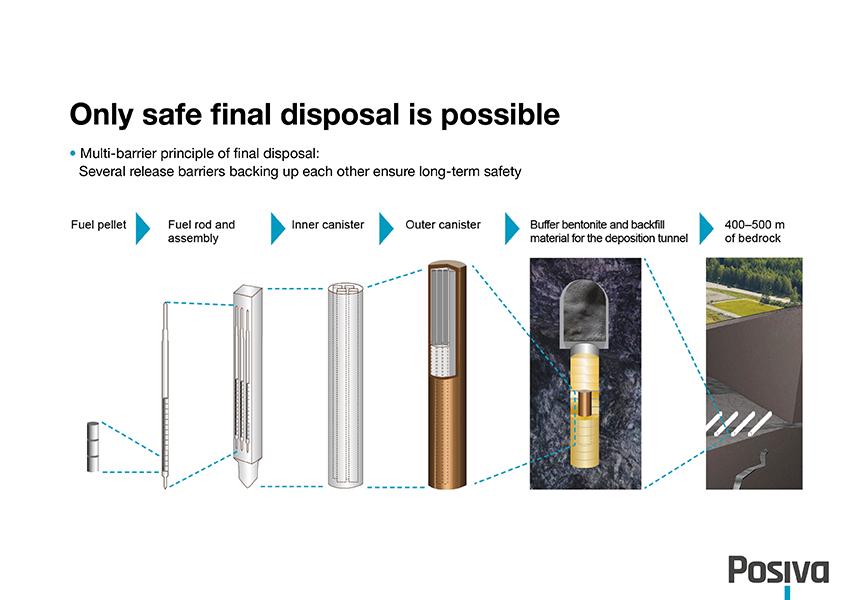
The long-term safety of final disposal is also very much based on the multi-barrier principle. In practice, this means that the radioactive materials are for final disposal contained inside several release barriers that are mutually supportive but also as redundant as possible. The logic of this principle is easy to understand. The key point is that the failure of any one release barrier will not affect the performance of the isolation. This has also been successfully demonstrated in the Safety Case in analyses of failures of one or several engineered barriers.
In Posiva’s final disposal solution, the spent nuclear fuel is packed in strong, watertight copper canisters. They are resistant to corrosion and mechanical wear and will retain their integrity for up to a hundred thousand years.
The sealed canisters are placed at a depth of 430 metres in deposition holes featuring a bentonite clay buffer to isolate them from people. There they remain intact and leak-tight without maintenance for as long as the content of the canisters could pose any essential risk to the living nature.
Responsibility is not transferred to future generations
The stance adopted in Finland is that finding a solution is not transferred to future generations. Instead, the final disposal of spent nuclear fuel is implemented using the best available knowledge. Underground final disposal is always a safer solution than storing spent nuclear fuel in interim repositories.
In the Finnish solution, the spent nuclear fuel can be recovered from the final disposal repository if a better method than the current one, while also sustainable and economically feasible, is developed at some point. It will be the easiest to do this during the next one hundred years while the production stage of final disposal is still ongoing. Once the facility has been sealed permanently, the recovery of the canisters from the final disposal repository will become more challenging.
Radioactivity halved the whole time
The radioactivity of spent nuclear fuel is reduced, or halved, much quicker than what Posiva promises the waste will stay isolated from the biosphere. In addition to being radioactive, the fuel is also a heavy metal and as such, due to its toxicity must also be kept isolated from people and nature.
The safety limits applied are very conservative. The upper limit of the annual radiation dose caused by final disposal over the foreseeable period of time to the representative person is set to 0.1 millisieverts (mSv), whereas the average effective annual radiation dose per person in Finland is 5.9 millisieverts (mSv).
In other words, the spent nuclear fuel stays even in the worst scenario safely isolated deep inside the bedrock without any risk of radioactive materials rising to the ground. One can actually talk about closing the circle – the uranium excavated from rock is returned to rock.
For more on this topic, go to Posiva - Long-term safety
Text: Pasi Tuohimaa
Photo: Tapani Karjanlahti
Share